

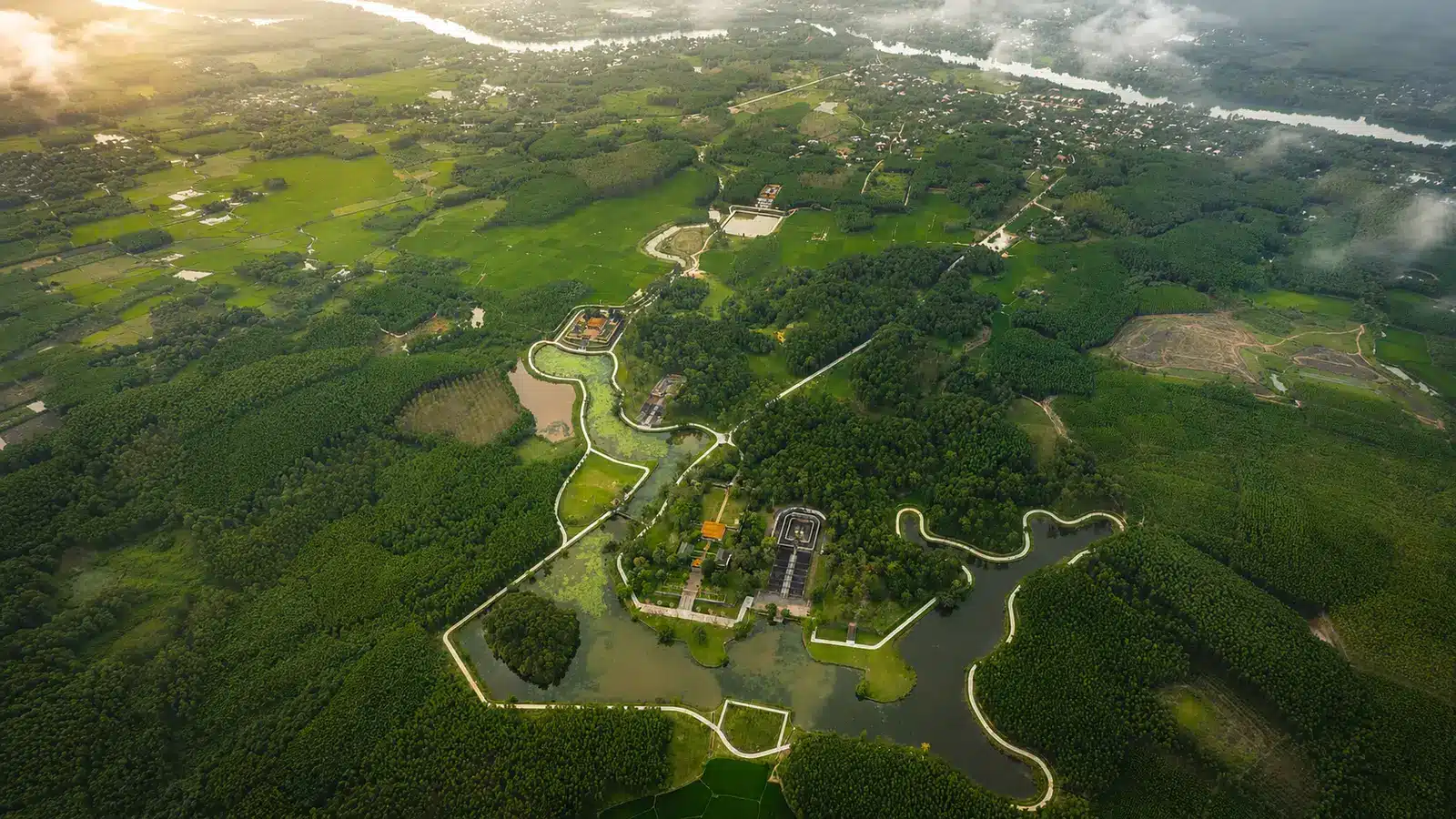
Set among the hills upstream of the Perfume River, Gia Long Tomb in Huế, also known as Thiên Thọ Tomb, has a character unlike any other Nguyễn imperial tomb in the city. The complex does not stand apart from nature; it unfolds across forest, water and successive layers of mountains.
The farther visitors travel into the Thiên Thọ landscape, the more clearly they feel its openness and tranquillity. Architecture never overwhelms the terrain here. Stone structures, temples, the stele pavilion and ceremonial courts only make full sense in relation to the sky, water and 42 surrounding hills.
The tomb also recalls a major milestone in Vietnamese history. In 1802, Emperor Gia Long founded the Nguyễn dynasty and established Huế as the capital of a reunified country governed by a central court.
If you are deciding which mausoleum to include in your Huế itinerary, begin with our overview of the Nguyễn dynasty royal tombs in Huế. Travellers who love nature, quiet places and the early history of the Nguyễn dynasty should allow at least half a day for Gia Long Tomb.
Gia Long Tomb visitor information for 2026
| Detail | Visitor information |
|---|---|
| Names | Gia Long Tomb, also known as Thiên Thọ Tomb |
| Current location | Kim Long Ward, Huế City; approximately 16–20 km from the central area, depending on your starting point |
| Journey time | Approximately 35–50 minutes by car or motorbike |
| Recommended visit | Allow approximately 90–120 minutes |
| September ticket-office hours | 6:30 am–5:30 pm under the Hue Monuments Conservation Centre’s summer schedule |
| Single-site ticket from 2 June 2026 | VND 150,000 per adult; free for children aged 7–12 |
| Minh Mạng–Gia Long route ticket | VND 240,000 per adult; VND 30,000 for children aged 7–12 |
Please note: This information was checked against the official Hue Monuments Conservation Centre website on 27 August 2026. Concessions, last admission and conservation closures may change. Check again shortly before travelling, especially during public holidays or periods of heavy rain and storms in Huế.
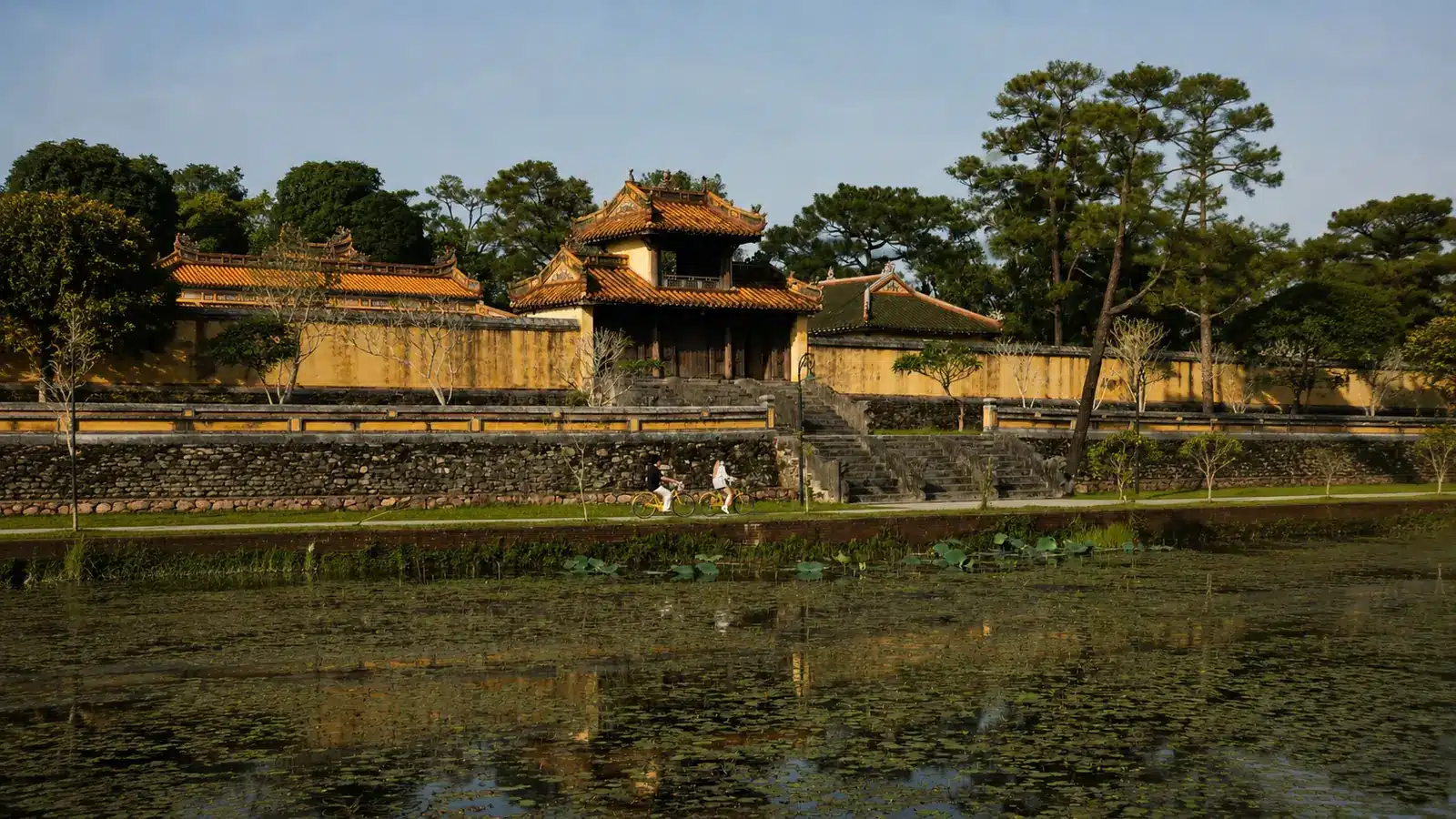
A landscape complex among 42 hills
Construction of Thiên Thọ Tomb began in 1814 and continued in the years that followed. Yet dates and lists of structures do not capture what makes Gia Long Tomb distinctive. Its most remarkable quality is the way the entire complex merges with the surrounding forest and mountains.
The Thiên Thọ area comprises 42 hills and mountains of different sizes, each of which once had its own name. Đại Thiên Thọ is the largest and was chosen as the natural screen in front of the tomb. Layers of hills support the composition from behind, while natural ranges enclose the central area on either side.
There is no continuous wall drawn tightly around the whole complex. The hills act as natural ramparts, while buildings are placed sparingly across a broad horizontal composition. The experience comes not only from the monuments themselves but also from the paths connecting them.
One stretch may pass beneath a canopy of trees; another opens across grass towards a mountain ridge. Clouds are reflected in still water and wind moves through the pines. Nature is not a backdrop at Gia Long Tomb in Huế; it is part of the monument itself.

Emperor Gia Long and the reunification of Vietnam
Emperor Gia Long, born Nguyễn Phúc Ánh, ascended the throne at Phú Xuân in 1802, adopted the reign name Gia Long and founded the Nguyễn dynasty. This marked the reunification of the territory from north to south under one government after a long period of division.
Gia Long’s defining achievement was to restore national unity across a vast territory and select Huế as the capital. From here, the court began to organize a unified system of government connecting the northern, central and southern regions within a single state.
In 1804, the national name Việt Nam came into official use. It was an important milestone in the history of the country’s name and reflected the idea of a unified nation under the new dynasty.
During his 18-year reign, Gia Long laid foundations for reorganizing administrative divisions, establishing the six ministries, managing land and taxation, expanding production, improving dykes, supporting education and developing the Huế Citadel. These measures created an early framework through which the Nguyễn court could govern a country extending from north to south.
A visit to Gia Long Tomb is therefore more than a tour of an old monument. It is an opportunity to reflect on the founding emperor of the Nguyễn dynasty, whose legacy is closely associated with the reunification of Vietnam and Huế’s rise as the national capital.
Thiên Thọ Tomb is not a single monument
The principal area of Gia Long Tomb is organized into three broad sections, arranged horizontally and oriented towards the mountain landscape in front.
At the centre is Bái Đình, the ceremonial court, with stone figures of civil and military mandarins and animals. From the lower court, successive terraces, ceremonial pillars, Bửu Thành and Đại Thiên Thọ Mountain form an open composition that feels solemn without becoming oppressive.
On one side stands Minh Thành Temple, an important place of worship within the complex. On the other is Bi Đình, the stele pavilion, which houses the “Thánh Đức Thần Công” stele commissioned by Emperor Minh Mạng to record his father’s achievements. Each area has its own space while remaining part of the wider Thiên Thọ landscape.
The broader complex also includes Thiên Thọ Hữu Tomb, Thoại Thánh Tomb, Hoàng Cô Tomb and several structures associated with the imperial family. Each occupies a separate hill and relates to lakes, streams and bands of forest. This dispersed arrangement makes Thiên Thọ feel more like a historic landscape than a concentrated visitor attraction.
Walk slowly and look from different elevations. From the ceremonial court, the water’s edge or a higher section of road, the buildings appear deliberately small within a natural setting of far greater scale.
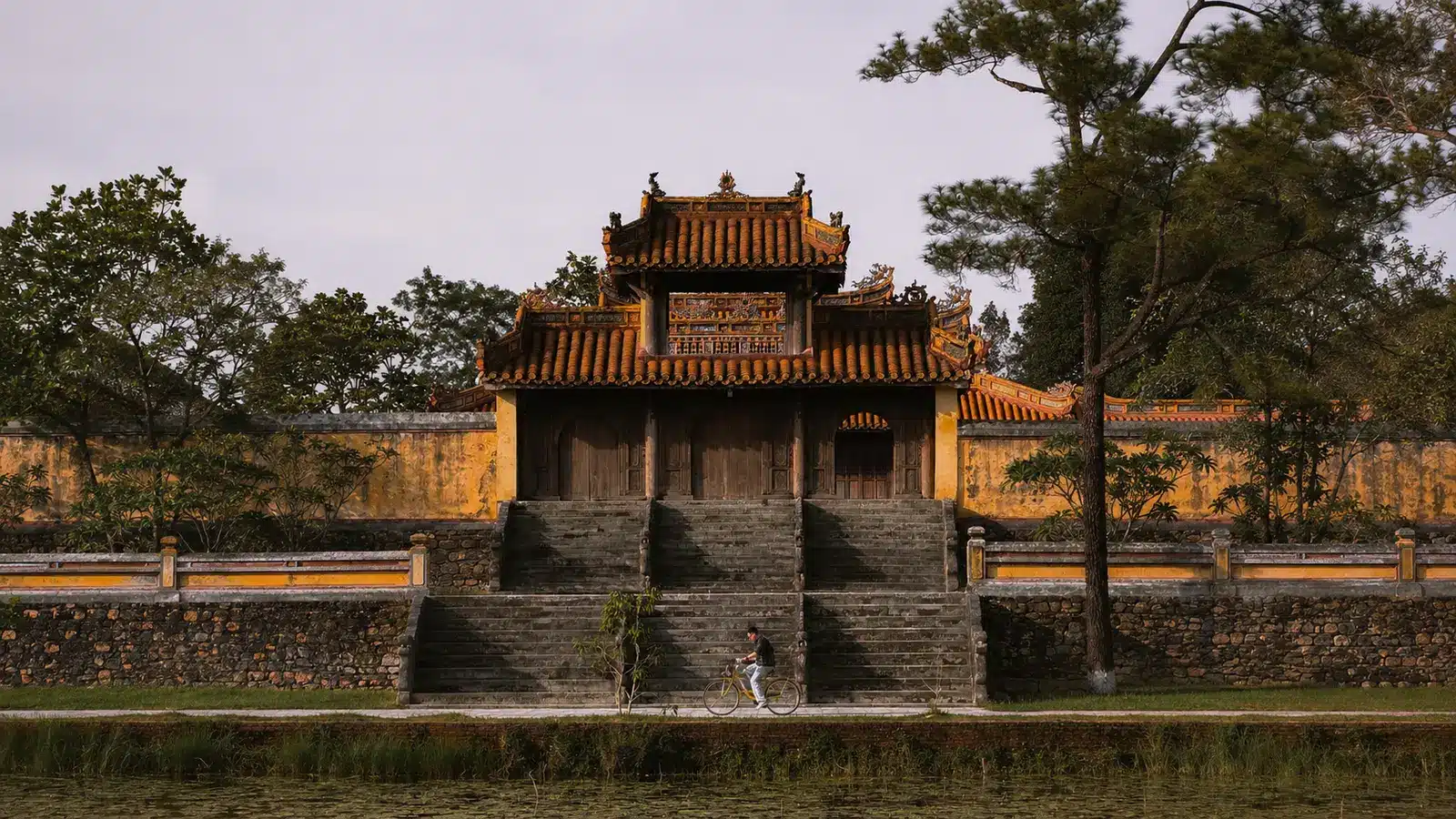
The tombs of the Nguyễn Lords beside the upper Perfume River
Gia Long Tomb does not stand alone in the hills. The former Hương Thọ area, around the upper Perfume River and the Bằng Lãng confluence, preserves the tombs of all nine Nguyễn Lords.
These leaders laid the foundations of the Nguyễn family’s rule, organized the southern territories and gradually expanded the country’s geographic space. The tombs around La Khê, Kim Ngọc, Hải Cát and Định Môn together form a broader historic landscape spanning generations before the Nguyễn dynasty was established.
Notable sites include:
- Trường Cơ Tomb, built for Lord Nguyễn Hoàng, who laid the foundations for the Nguyễn Lords’ rule. Emperor Gia Long had the tomb rebuilt and named Trường Cơ in 1808.
- Trường Diễn Tomb of Lord Nguyễn Phúc Nguyên and Trường Diên Tomb of Lord Nguyễn Phúc Lan.
- Trường Hưng Tomb of Lord Nguyễn Phúc Tần, Trường Mậu Tomb of Lord Nguyễn Phúc Thái and Trường Thanh Tomb of Lord Nguyễn Phúc Chu.
- Trường Phong Tomb of Lord Nguyễn Phúc Chú, in the Định Môn area and geographically close to the Thiên Thọ landscape.
- Trường Thái Tomb of Lord Nguyễn Phúc Khoát, who is associated with dress reforms that helped shape the Vietnamese áo dài. The site lies near the road through La Khê towards Gia Long Tomb.
- Trường Thiệu Tomb of Lord Nguyễn Phúc Thuần in the La Khê Trẹm area.
The tombs of the Nguyễn Lords are generally smaller and architecturally simpler than those of the emperors. Their most striking shared quality is the choice of terrain: a hill behind, water, a stream or fields in front, and natural ridges providing protection on either side.
Not all nine tombs are included in the ticketed Gia Long visitor route. Some lie far from the main road or may be undergoing conservation and landscaping work. Follow official signs, ask staff for current access information and do not enter unmarked tracks or local farmland.
Seen in this wider context, the journey to Gia Long Tomb passes through many layers of Nguyễn history: from the Lords who developed and administered the southern territories to the emperor who reunified the country, founded the Nguyễn dynasty and made Huế its capital.
Scenery that changes along every section of the route
Gia Long Tomb is most rewarding when visitors do not rush. The scenery changes continuously with the path and the elevation.
In places, the path narrows between rows of trees, creating a sense of depth and quiet. A little farther on, the landscape suddenly opens across a lake, grass, ceremonial pillars and distant mountains. Morning light is usually soft, with moisture still on the foliage and the sky reflected on the water.
Late in the afternoon, angled sunlight filters through the pine forest and stretches across the stone courts. Distant mountain layers gradually shift from green to purple, emphasizing the tomb’s contemplative mood. Arrive by around 3:00 pm, however, to leave enough time to explore and exit the route before closing.
The dry season makes paths easier and views clearer. Light rain gives the forest a deeper green, brings out the scent of damp earth and creates a distinctly Huế atmosphere. In heavy rain, stone steps and leaf-covered paths can become slippery, so take particular care.
Getting to Gia Long Tomb: which transport should you choose?
From central Huế, a car, taxi or motorbike provides the most flexibility. The route follows the upper Perfume River towards the Tuần area before signs direct visitors to the tomb.
The final stretch is quiet and passes through green areas and fields. Some sections can be narrow or covered with leaves after rain, so check the route on an online map before setting out.
- Motorbike: suitable for confident riders who want the freedom to stop for the scenery. Check fuel and tyres, and carry rain gear.
- Taxi or car: convenient for families, groups and older travellers. Agree on waiting time in advance or arrange your return journey.
- Bicycle: choose this only if you are accustomed to long distances, heat and sustained physical effort.
- River route: some private itineraries combine a boat with a road transfer. Book through a licensed operator and confirm the landing point and return time.
Use our Huế Travel Guide 2026 to place Gia Long Tomb within a one- or two-day itinerary without rushing between monuments.

Best time to visit and practical tips
From 6:30 to around 9:30 am is usually the most comfortable time in September. The sun is lower, the stone courts have not stored the day’s heat and the site tends to be quieter. For an afternoon visit, arrive at around 3:00 pm to leave enough time to experience the landscape.
Gia Long Tomb covers a wide area and includes many steps. Bring:
- Shoes with reliable grip.
- Drinking water, a hat and sunscreen.
- A compact raincoat during changeable weather.
- Insect repellent for an early-morning visit.
- Respectful clothing that covers shoulders and knees in worship areas.
Older travellers, wheelchair users and families with pushchairs should ask staff about the most suitable route. Distances can be considerable, and not every section is convenient for mobility aids.
A wide-angle lens is useful for the landscape, but the beauty of Gia Long Tomb cannot be contained in a single frame. Take time to pause, watch the changing light and sense the breadth of the surrounding hills and forest.
A half-day Gia Long–Minh Mạng itinerary
6:30 am: Have breakfast in central Huế.
7:15 am: Depart for Gia Long Tomb.
8:00–9:45 am: Visit Bái Đình, Bi Đình, Minh Thành Temple and the principal sights of the Thiên Thọ area.
10:00 am: Travel to Minh Mạng Tomb.
10:30 am–noon: Explore Hiếu Lăng, then return to the city.
Visit Gia Long first because it is farther away, more extensive and requires more walking. Minh Mạng Tomb has a more concentrated visitor route, with a balanced architectural plan and a clearer sequence of monuments.
If you want to learn more about the tombs of the Nguyễn Lords, watch for official signs along the La Khê–Kim Ngọc–Định Môn route and ask staff about current access to each site. Do not try to pack too many stops into a single morning.
Back in central Huế, use our guide to Huế food and craft-beer pairings to choose bún bò, Huế cakes, cơm hến or another convenient local meal.
Why is Gia Long Tomb different from other Nguyễn imperial tombs?
Each imperial tomb in Huế has its own character.
Minh Mạng Tomb is distinguished by its balanced architectural axis, lakes and carefully ordered layers of buildings. Khải Định Tomb makes an impression through architectural density, materials and elaborate decoration.
Gia Long Tomb, by contrast, draws its power from the scale of nature. The architecture is restrained and widely spaced, allowing the hills, pine forest, water and broad skies to dominate.
It is especially suited to travellers who love landscapes, want to understand the early Nguyễn dynasty or prefer a less crowded heritage setting. Rather than entering a palace, the visit feels like a journey through mountain country holding many layers of history.
In the evening, browse the craft beers brewed at Đông Ba Brewery and reserve a table if you are travelling with a group. The taproom at 14 Nguyễn Sinh Cung opens from 5:00 pm. Please drink responsibly and never drive after consuming alcohol.
Frequently asked questions about Gia Long Tomb
Is Gia Long Tomb worth visiting if I have only one day in Huế?
Yes, if you love nature, are interested in the early Nguyễn dynasty and can devote at least half a day. If you have only about two hours for both travel and sightseeing, choose a tomb closer to the city centre.
How long should I spend at Gia Long Tomb?
Allow 90–120 minutes for the principal route. Visitors who want to read the inscriptions, take photographs or explore more of the Thiên Thọ landscape should stay longer.
How much is admission to Gia Long Tomb in 2026?
Under the price schedule effective from 2 June 2026, a single-site ticket is VND 150,000 for adults and free for children aged 7–12. The Minh Mạng–Gia Long route ticket is VND 240,000 per adult and VND 30,000 per child aged 7–12.
Can I visit Gia Long and Minh Mạng tombs in the same half-day?
Yes. The two sites can be combined because both lie southwest of Huế and are covered by a joint route ticket. Start early and allow approximately 1.5–2 hours at each tomb.
Are the tombs of the Nguyễn Lords inside Gia Long Tomb?
Not all of them. The tombs of the nine Nguyễn Lords are distributed across the former Hương Thọ area around the upper Perfume River. Some lie close to the approach to Gia Long Tomb, but they are not part of the same ticketed attraction. Trường Phong Tomb is especially close geographically to the Thiên Thọ heritage landscape.
Why does Gia Long Tomb have a wider landscape than many other imperial tombs?
The complex was created within an area of 42 hills and mountains. Its composition uses the terrain, water and natural ridges themselves rather than concentrating every structure within a tightly enclosed site.
Sources
- Hue Monuments Conservation Centre – Emperor Gia Long’s Tomb
- Hue Monuments Conservation Centre – official ticket prices
- Hue Monuments Conservation Centre – official visitor hours
- UNESCO World Heritage Centre – Complex of Hué Monuments
- Vietnam National Museum of History – Emperor Gia Long and the founding of the Nguyễn dynasty
- Báo Văn Hóa – the tombs of the Nguyễn Lords in the Hương Thọ area