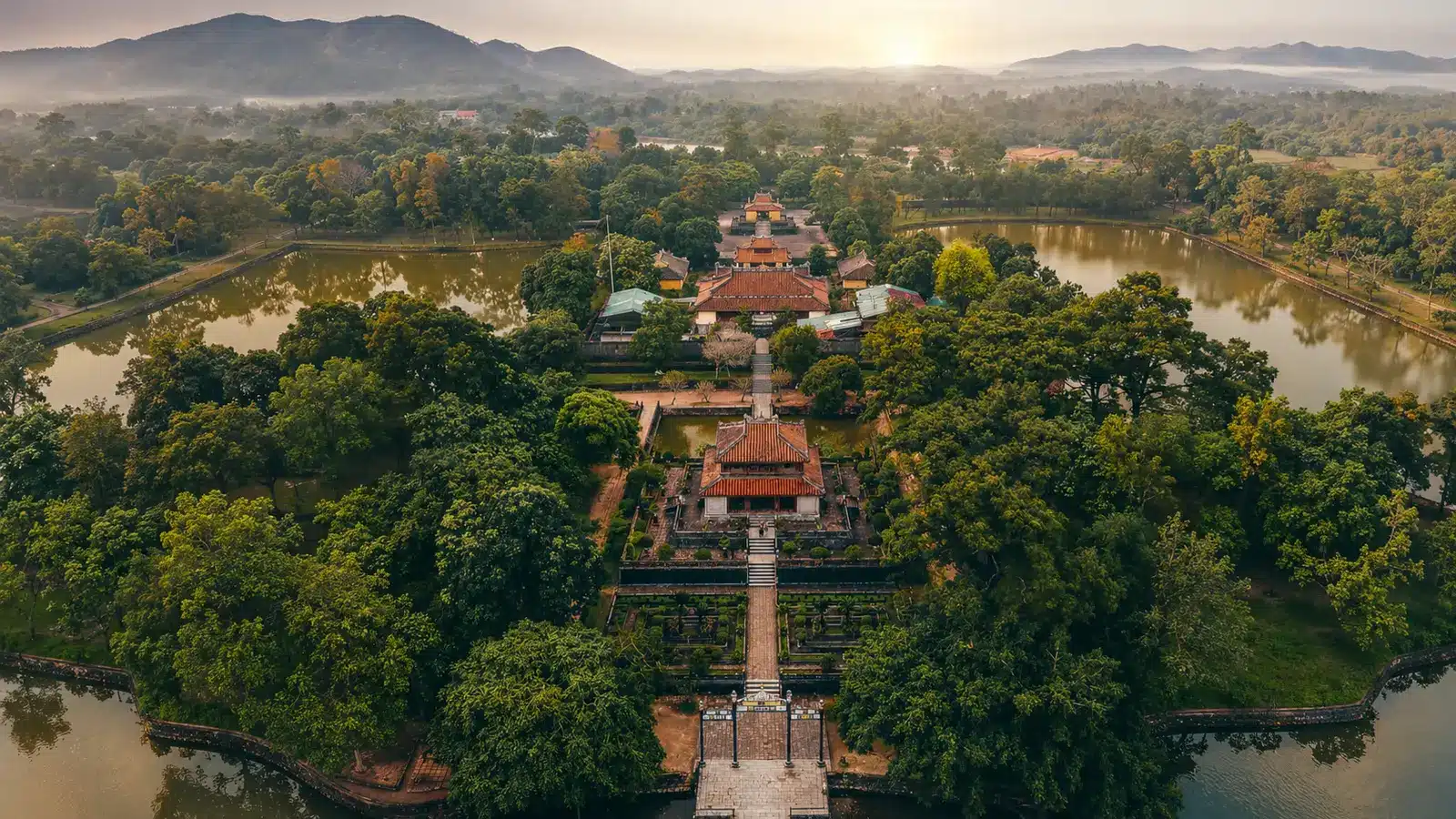
Minh Mạng Tomb in Huế, also known as Hiếu Lăng or the Tomb of Filial Piety, does not rely on dense ornament to make an impression. Its power unfolds gradually: a ceremonial gate opens onto a court, the court leads to a place of worship, and formal architecture then gives way to lakes, stone bridges, wooded hills and a sealed burial mound. The entire complex feels like a journey composed in space.
If the Imperial City shows the Nguyễn court in operation, Minh Mạng Tomb reveals how it imagined order, remembrance and eternity. Reading the sacred central axis turns a sequence of monuments into a coherent journey.
Contents
Minh Mạng Tomb visitor information for 2026
| Visitor detail | Reference information |
|---|---|
| Formal name | Hiếu Lăng, commonly translated as the Tomb of Filial Piety |
| Location | On Cẩm Khê hill near the Bằng Lãng confluence, where the Tả Trạch and Hữu Trạch branches form the Perfume River; roughly 12–14 km from central Huế, depending on your starting point |
| Recommended time | About 90–120 minutes for an unhurried visit |
| September hours | Visiting time 6:30 AM–6:00 PM; ticket office 6:30 AM–5:30 PM, according to official information checked on 27 August 2026 |
| Reference single-site ticket | VND 150,000 per adult; VND 30,000 for children aged 7–12 |
| Best for | Architecture, history, landscape, photography and slow travel |
Important: prices, hours and visitor routes can change. Check the official ticket prices and opening times before travelling, and avoid arriving just before ticket sales end.
From Emperor Minh Mạng’s plan to the completed Hiếu Lăng
Emperor Minh Mạng, born Nguyễn Phúc Đảm, was the second Nguyễn emperor. He succeeded Gia Long in 1820 and pursued reforms to strengthen a centralised, tightly organised state. His preference for order is often used to interpret the tomb’s balanced plan.
After a long search, Cẩm Khê near the meeting of two river branches was chosen, renamed Hiếu Sơn, and the tomb called Hiếu Lăng. Work began in 1840. Minh Mạng died in early 1841 before completion, so Emperor Thiệu Trị continued the project, interred his father later that year and substantially finished the complex by 1843. Hiếu Lăng is now a component of the UNESCO-listed Complex of Hué Monuments.

The sacred axis at Minh Mạng Tomb: one line, several worlds
The key to the architecture of Minh Mạng Tomb in Huế is its sacred axis, or thần đạo. Principal structures follow the centre while secondary elements balance either side. Rising ground, roofs behind trees and expanses of water prevent the line from feeling rigid.
The route moves through four realms: court ceremony; ancestral worship at Sùng Ân Temple; reflection around Trừng Minh Lake and Minh Lâu; then burial beyond Tân Nguyệt Lake. It is often interpreted through Neo-Confucian hierarchy, geomancy and yin–yang thought. Even without knowing every symbol, visitors can feel the progression from broad and ceremonial to green, quiet and enclosed.
A step-by-step route through Minh Mạng Tomb
1. Đại Hồng Môn and the Honour Courtyard: ceremony comes first
Đại Hồng Môn has three passages beneath layered roofs; its central way is associated with the emperor’s funeral, not everyday circulation. The Honour Courtyard beyond contains aligned stone mandarins, elephants and horses. Turn back to compare both sides and watch the centre line point towards the Stele Pavilion. Early light gives the figures greater definition.
2. The Stele Pavilion: a reign translated into text
The pavilion houses the Thánh Đức Thần Công stele, composed by Thiệu Trị in memory of his father. Stone officials yield to a written account of imperial virtue, while the changing terrain reveals the tomb as a paced landscape rather than isolated façades.
3. Hiển Đức Gate and Sùng Ân Temple: the centre of remembrance
Hiển Đức Gate opens into the temple precinct, centred on Sùng Ân Temple and the tablets of Minh Mạng and Empress Tá Thiên Nhân. The court’s public hierarchy gives way to family and ancestral rites. Keep voices low, follow photography rules and view the red-gold details, timber and roofs as a ritual ensemble.
4. Hoằng Trạch Gate, Trừng Minh Lake and three stone bridges
Beyond Hoằng Trạch Gate, Trừng Minh Lake and the Trung Đạo, Tả Phù and Hữu Bật bridges soften architectural formality. The arch frames the classic view across the central bridge to Minh Lâu. Step slightly aside for roof reflections and to share the viewpoint; after rain, use care on slippery stone.
5. Minh Lâu: the Pavilion of Light
Minh Lâu is a two-storey, eight-roofed pavilion on Tam Tài Sơn. The “Pavilion of Light” is both visual climax and threshold to the burial realm. Here wind, leaves and open sky loosen strict symmetry. Nearby obelisks and a garden traditionally shaped as a Thọ character evoke longevity.

6. Tân Nguyệt Lake, the Thông Minh Chính Trực bridge and Bửu Thành
Crescent-shaped Tân Nguyệt Lake embraces the burial hill, and the Thông Minh Chính Trực bridge leads to circular Bửu Thành. A familiar reading sees the lake as yin and the rounded mound as yang. Visitors approach but do not enter the sealed resting place, preserving a final boundary between public landscape and burial realm.
Where architecture, nature and philosophy meet
At Minh Mạng Tomb, order does not eliminate nature. Lakes, hills and trees provide rhythm: buildings direct the eye while open spaces slow the body. UNESCO likewise emphasises how Huế’s monuments were placed within nature and aligned with traditional cosmological ideas.
A popular interpretation compares the overall landscape to a reclining human figure, with the head supported by hills and the feet extending towards the meeting of the rivers. It is best understood as an evocative way of seeing the site, not as a literal anatomical blueprint. The deeper point is that architecture and terrain were composed as a single body.
For comparison, Gia Long Tomb in Huế spreads more freely through a vast mountainous landscape, while Hiếu Lăng feels concentrated and disciplined. Our overview of the Nguyễn dynasty royal tombs in Huế can help you decide which sites best match your time and interests.

Practical tips: when to go, how to get there and what to combine
- Start early: 6:30–9:00 AM is comfortable and quieter. For an afternoon visit, enter before about 3:30 PM.
- September weather: check the forecast; carry a light rain jacket and waterproof phone pouch.
- Dress respectfully: cover shoulders and knees in worship spaces, and wear shoes with grip.
- Water: bring a small bottle, avoid eating in worship areas and remove all waste.
- Getting there: taxi, ride-hailing, car or motorbike take roughly 25–35 minutes from central Huế. Map the route and slow down through residential sections.
- Interpretation: a guide or on-site service makes the gates, temples and symbols easier to understand.
A half-day can pair Minh Mạng with Gia Long. The official site currently lists this route ticket at VND 240,000 per adult and VND 30,000 for ages 7–12; confirm conditions when purchasing. If adding the Imperial City or other tombs, use our 2026 Huế Travel Guide to keep the plan realistic.
What to do after a day among Huế’s royal tombs
After several hours outdoors, rest, try local food and walk near Đập Đá or the Perfume River. You can also preview Đông Ba’s craft beers brewed in Huế and book a table at Đông Ba Brewery. Drink responsibly and never drive after alcohol.
Frequently asked questions about Minh Mạng Tomb
How far is Minh Mạng Tomb from central Huế?
The journey is generally 12–14 km. A taxi or motorbike normally takes about 25–35 minutes.
How long should I spend at Minh Mạng Tomb?
Allow 90–120 minutes to appreciate the transition from ceremonial court to water landscape and burial enclosure.
How much is the Minh Mạng Tomb ticket in 2026?
On 27 August 2026, the official page listed VND 150,000 for adults and VND 30,000 for ages 7–12. Verify prices before visiting.
Can I visit Minh Mạng and Gia Long tombs in one half-day?
Yes, if you start early and have transport. Minh Mạng is concentrated and symmetrical; Gia Long is expansive and embedded in its terrain.
What is the best photo viewpoint?
The classic view runs from Hoằng Trạch Gate across Trừng Minh Lake towards Minh Lâu. The early Honour Courtyard and Tân Nguyệt Lake also reward photographers.
Is the tomb suitable for older visitors?
The site involves a long walk and many steps. Move slowly, rest, avoid midday heat and ask staff about the most suitable route.